Contents
Daegongwon Station and the general car park are close to the same arrival edge, but visitors still cross a broad outdoor area past the central fountain toward the zoo. The practical difference between car and subway is therefore the return fatigue, parking settlement and sheltered time—not a promise of door-to-door arrival. This plan uses official information checked November 20, 2026. It does not guarantee a parking space, crowd level, weather or outdoor animal viewing.
- Subway
- Line 4 Daegongwon Station exits 1–3 · weekend/holiday recommendation
- Car
- KRW 5,000 mobile daily cap · KRW 6,000 pre/exit daily cap
- Winter
- Zoo 09:00–17:00 November–February · last entry one hour before
- Rain fallback
- Greenhouse 10:00–17:00 · last entry 16:30
Both choices still end with walking inside the park
The subway choice starts at Line 4 Daegongwon Station exits 1, 2 or 3. Seoul Grand Park recommends the subway on weekends and holidays to avoid parking and nearby road congestion. Add your origin-station transfers and the actual exit or lift needed for your group.
For a car, use 359 Makgye-dong, Gwacheon-si, Gyeonggi-do for the general car park. Ordinary cars and taxis cannot continue into the visitor area, so a car is not a ride to the zoo gate. It helps with luggage and waiting out rain, while adding driver fatigue on the way home.
Apply at least two group constraints together
A car may suit a stroller, umbrellas, spare clothes or a companion who needs a break in the vehicle. A space close to the approach is not guaranteed, and walking or separate internal transport remains after parking.
For one or two adults comfortable with the station approach, the subway avoids driving and may be simpler on busy days. No driving after a long visit is a real advantage. A companion who finds lift transfers or longer walks difficult should compare the whole journey from the origin station.
The free internal electric loop is for mobility-impaired visitors and one companion, not a general shuttle. The winter listing gives 10:00–12:00 and 13:00–16:30 at roughly 30-minute intervals, with peak-period suspensions and visit-day changes to reconfirm.
| Choice | Best fit | Constraint to accept first |
|---|---|---|
| Subway | Weekend traffic avoidance · no driving | Origin transfers · outdoor walking after the station |
| Car | Stroller or luggage · vehicle rest · flexible return | Parking settlement · uncertain spaces · driver fatigue |
| Mobility loop | Eligible visitor and one companion | Not for general visitors · operation can change |
Work backwards from the 17:00 winter close
From November through February the zoo is listed 09:00–17:00, with last entry one hour before closing. An illustrative sequence is arrival around 09:30, zoo entry around 10:00, 70 minutes outdoors, a 50-minute meal and seated rest, 60 minutes in the greenhouse, one 60-minute optional zone and an early exit transition.
This is not an operator tour or guaranteed route. The blocks are editorial planning allowances. Shorten or skip them for animal location, queues, toilets, a stroller, wheelchair or mobility aid. Animals may move indoors early for weather or condition.
| Block | Example | Reason to change |
|---|---|---|
| Arrival and orientation | 09:30–10:00 | Parking, exit or ticket delay |
| First outdoor zone | 10:00–11:10 | Rain, cold or animals moving indoors |
| Meal and seated rest | 11:10–12:00 | Reverse the order for a long queue |
| Greenhouse | 12:00–13:00 | Opens 10:00 · last entry 16:30 |
| Optional viewing and exit | From 13:00–14:30 | Turn back well before 17:00 |
In rain, build around one indoor anchor
The greenhouse is listed 10:00–17:00 with last entry at 16:30. Shorten outdoor blocks and increase greenhouse and indoor time, but do not treat a rain forecast as proof that the zoo is closed or fully normal. Recheck the official popup and hours before leaving.
Use 30–45 minute outdoor blocks followed by shelter, food or seated rest instead of rushing the whole park under umbrellas. For high wind or heavy rain, reducing or postponing the plan comes first; this guide does not promise refunds or transport operation.
Read only the station–fountain–zoo sequence
The official guide map supports a simplified sequence: station and general parking at the lower arrival edge, fountain and information in the centre, and the zoo entrance and greenhouse farther into the park. Blue water and green land are broad editorial fields, not a surveyed shoreline.
Scale, exact north, distance, roads, railway, stairs, actual paths and entrances are omitted. The image contains no route line or words. Use official directions, the guide map and onsite signs for navigation.
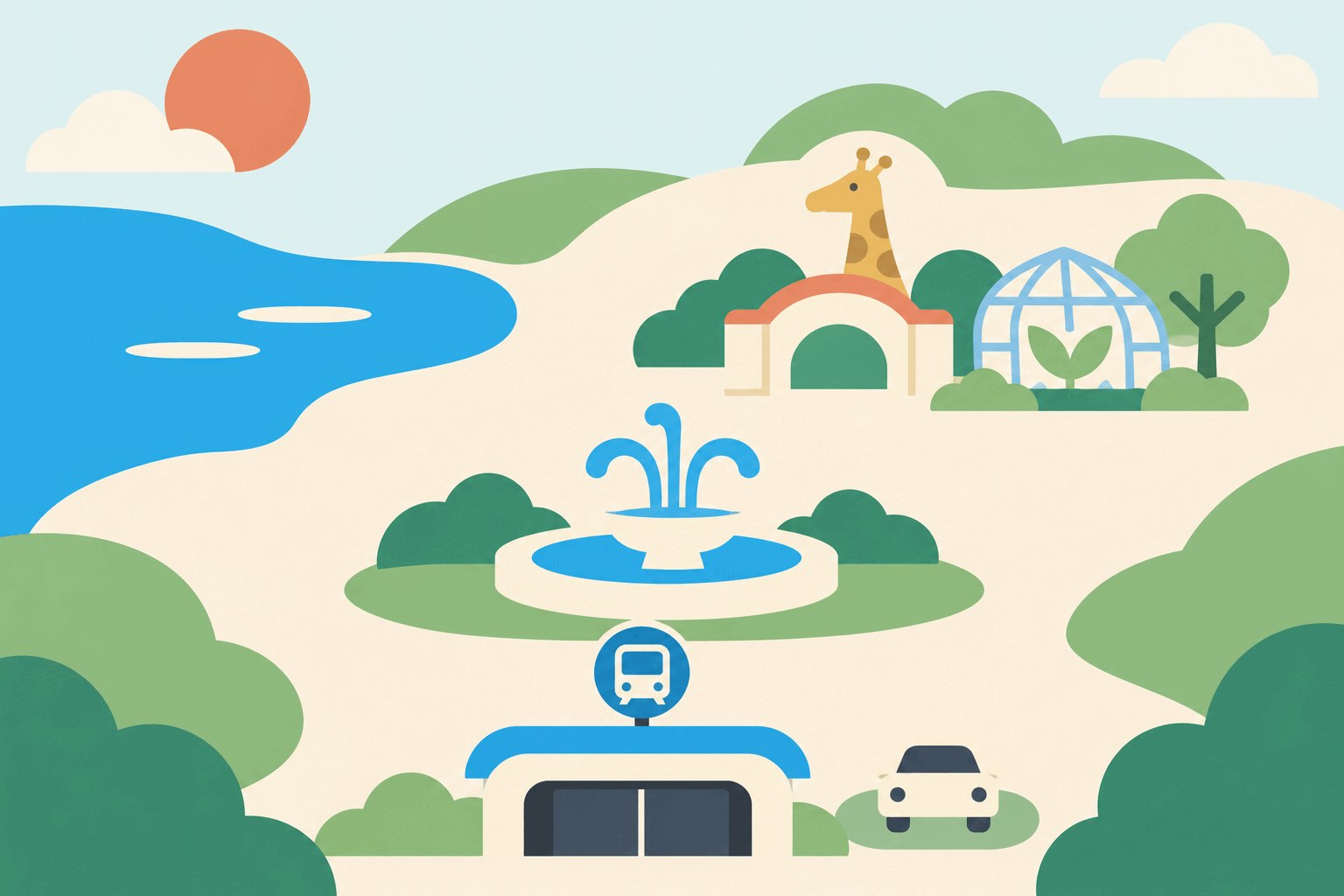 1Daegongwon Station2General parking arrival3Central fountain and information4Zoo entrance5Botanical greenhouseStation and general parking–fountain and information–zoo and greenhouse orientation · no scale, exact bearing, distance, roads, railway, stairs or real paths
Separate verified fixed charges from optional spending
Adult zoo admission is KRW 5,000. Two adults cost KRW 10,000; adding the listed KRW 5,000 mobile-settlement daily parking cap gives KRW 15,000 in verified fixed charges. Using the KRW 6,000 pre/exit-settlement daily cap gives KRW 16,000.
Subway, fuel, tolls, elephant train, food, drinks and activities vary and are excluded. KRW 18,000 for a meal and KRW 6,000 for a drink can be per-person assumptions, not official prices. Recheck the mobile parking condition and any discount eligibility.
| Item | Amount | Condition |
|---|---|---|
| Adult zoo admission | KRW 5,000 per person | Check official discount and free categories |
| Mobile parking | KRW 5,000 daily cap | Official mobile-settlement table |
| Pre/exit parking | KRW 6,000 daily cap | Exit within 30 minutes after prepayment |
| Free turnaround | Within 30 minutes | Beyond that, charge starts from entry |
Check opening, arrival and return once each
Before leaving, check zoo and greenhouse hours and notices. Near arrival, check the car park or station exit. Before departure, check parking settlement or the return train. If you prepay parking, plan the walk back to the car within the official 30-minute exit grace.
A zoo outdoor zone, the greenhouse, food and rest make a more resilient day than trying to see everything. Do not reuse the date of an earlier event or last year's foliage as a current condition for this visit.
Frequently asked questions
Can I drive from the car park to the zoo entrance?
Ordinary cars and taxis are restricted beyond the parking area. Continue on foot or check official internal transport operating that day.
Can I see the whole zoo indoors when it rains?
No. The greenhouse and some indoor choices help, but much of the movement and viewing is outdoors. Animals may also move indoors early for weather or condition.
Can every visitor use the free electric loop?
No. The official listing is for mobility-impaired visitors and one companion, with operating hours and suspension conditions to reconfirm.
Summary
Compare subway and car for Seoul Grand Park through weekend traffic, KRW 5,000 or 6,000 parking caps, walking inside the park and a rain fallback. Work backwards from the 17:00 winter close around the greenhouse, food and rest.